AI for Space Systems Autonomous Inspection (Patent-Pending) R&D & Advisory

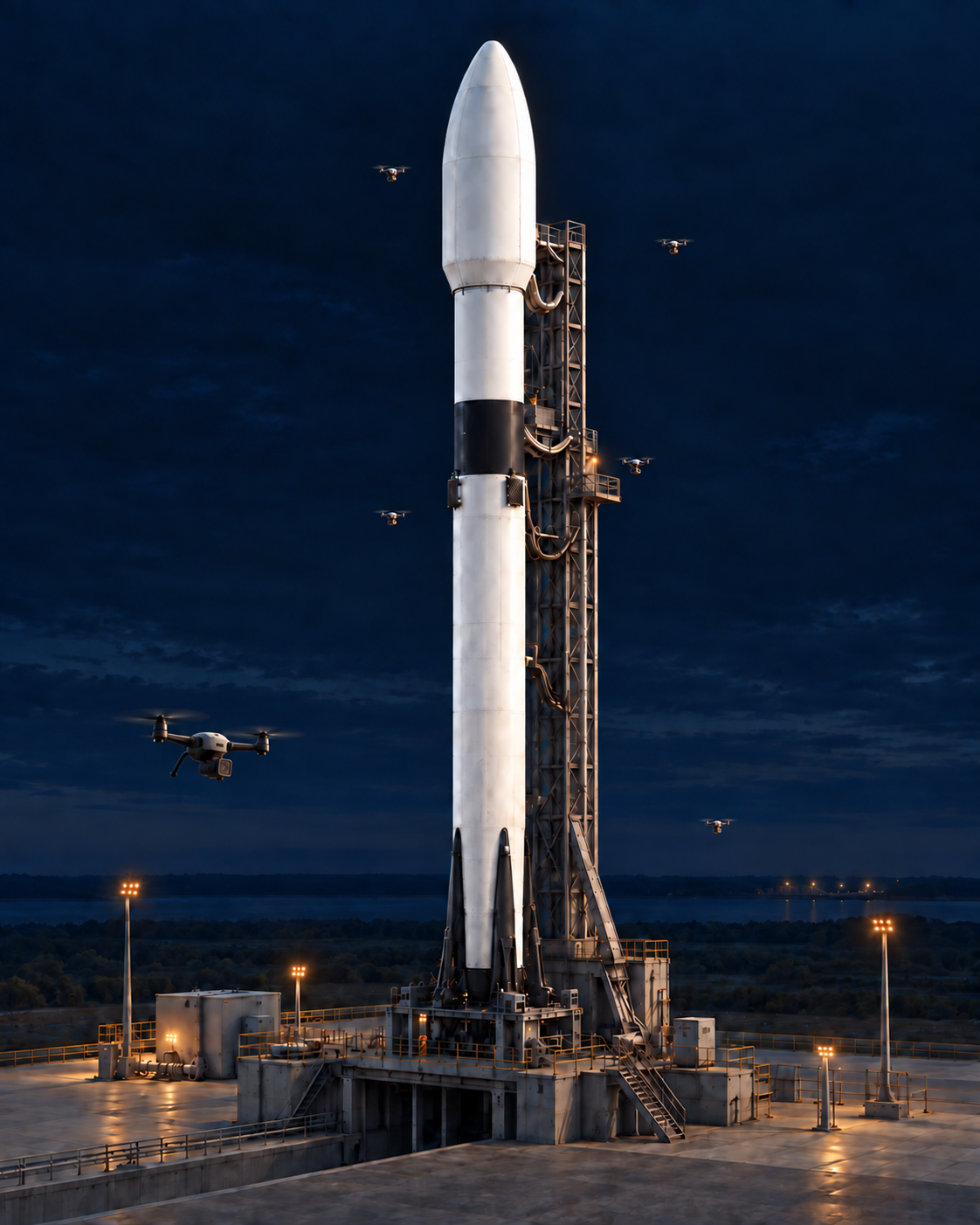
Autonomous Drone Swarms for Safer, Faster Launch Operations

An AI-first space technology company. Our flagship: autonomous drone swarms designed to inspect launch vehicles and pads before and after flight — a faster, safer, more scalable path beyond today’s slow, costly, and hazardous manual inspections. Grounded in the founder’s UC Berkeley research, and patent-pending.

Mission

Making launch operations more autonomous, safer, and scalable.

Space launch operations depend on critical pre- and post-launch inspections of vehicles and infrastructure — work that is traditionally manual, costly, time-consuming, and hazardous to personnel, and that does not scale as missions grow in complexity and frequency. SpaceTech AI pairs rigorous space-systems engineering with modern machine learning to change that, beginning with our flagship: autonomous drone-swarm inspection. We believe lasting capability comes from balancing innovation with stewardship — building real technology, and being honest about what the evidence shows.


How It Works

Inspection by drone swarm, in plain terms.

Instead of relying only on manual walkdowns, the concept uses a coordinated swarm of camera- and sensor-equipped drones to collect repeatable inspection evidence while machine learning flags what needs a closer look. The modeled target: lower inspection cost, faster turnaround, and fewer people near hazardous infrastructure.

Step 01

Deploy the swarm

A coordinated swarm of autonomous drones is sent up around the vehicle and ground infrastructure — no scaffolding, no crews working at height.

Step 02

Scan everything

Each drone captures high-resolution imagery and sensor data across the vehicle and pad — covering more surface, more thoroughly, than a manual walkdown.

Step 03

Detect anomalies

Machine-learning models flag defects and irregularities automatically, so engineers spend their time on the findings that actually matter.

Research & Evidence

Our advanced statistical model projected a lower-cost, faster, safer inspection path.

The founder’s 2024 concept-development research at UC Berkeley used a Python-based statistical simulation to model what launch providers actually buy: lower inspection cost, shorter turnaround, and less personnel exposure near hazardous infrastructure. Detection support still matters, but the commercial case starts with cost, schedule, and safety.

Core design finding

10–20 coordinated drones is the modeled operating window for cost, turnaround, and personnel exposure.

That range is the product clue: SpaceTech AI is not selling “more drones.” The business is inspection intelligence — a practical operating envelope where coordinated coverage, sensor fusion, ML triage, and human review can attack the cost, downtime, and safety exposure of manual walkdowns.

10–20
drone design window
1–100
swarm sizes tested
1,000,000
iterations per swarm size
What the model varied
  • Manual baseline Team size, hourly rates, inspection duration, training, and insurance costs.
  • Drone-swarm case Drone team size, labor, inspection time, base costs, advanced sensors, and maintenance.
  • Operational friction Battery life, weather delay, safety factors, and coordination losses as swarm size increased.
Up to 60% Modeled cost reduction Concept-development simulation maximum versus traditional manual inspection assumptions.
Up to 70% Modeled time reduction Smaller coordinated swarms produced faster inspection turnaround in the model.
Up to 50% Modeled safety improvement Concept-development simulation maximum; fewer people near hazardous launch infrastructure during inspection.
Up to 40% Modeled detection support Secondary simulation output under model assumptions; not measured field performance.

Source: Daniel Ryan Singleton, “Enhancing Space Operations Efficiency and Safety Using Drone Swarms for Pre- and Post-Launch Inspections,” concept-development research and simulation presented at the 2024 von Braun Space Exploration Symposium, University of California, Berkeley, College of Engineering. Results are Monte Carlo simulation findings, not delivered customer outcomes, guaranteed product results, or field-validated performance; model V&V, real-world testing, concept-risk evaluation, and calibration remain future work.

What We Do

Two ways we move missions forward.

01 — Capability

AI for Space Systems

We apply machine learning and modern AI to space operations across the mission lifecycle — from the launch segment through on-orbit operations. Our flagship R&D effort is autonomous drone-swarm inspection for launch vehicles and infrastructure: coordinated drones carrying advanced sensors and machine-learning anomaly detection, sized around the 10–20 drone design window highlighted by the founder’s UC Berkeley Monte Carlo concept-development research.

  • ML-driven autonomous drone-swarm inspection for launch vehicles and infrastructure — patent-pending, grounded in the founder’s UC Berkeley research
  • Sensor- and ML-based anomaly detection for vehicles and ground infrastructure
  • Deep-learning defect detection for composite launch-vehicle structures — an early proof-of-concept from the founder’s UC Berkeley research
02 — Capability

R&D & Advisory

We provide independent research, consulting, and advisory services in space systems and operations, built to work alongside technical teams and decision-makers. We assess approaches, de-risk architectures, and stress-test where AI models break before anyone relies on them — bringing the same evidence-first discipline our own research is held to.

  • Independent technical assessment and architecture review
  • Applied research and prototyping in space systems and operations
  • Strategy and roadmapping for space technology and AI adoption
Research & Prototyping

From research toward real capability.

We do not advertise products we have not built. SpaceTech AI grounds its work in real research and working software prototypes, and we are deliberate about stating how mature each one is — our flagship inspection concept is modeled in simulation, our deep-learning detection models are early proof-of-concept, and a few directions are still exploratory. Here is exactly where each one stands today.

Flagship · Patent-Pending

Autonomous Swarm Inspection

ML-driven drone swarms designed to inspect launch vehicles and ground infrastructure. The founder’s UC Berkeley Monte Carlo concept-development research indicated a swarm could reduce inspection cost, compress turnaround, and reduce personnel exposure versus manual inspection, while highlighting a 10–20 drone design window before coordination losses erode the advantage. These are simulation findings, not delivered customer outcomes.

Maturity
  1. Complete: Modeled in simulation
  2. Verification & validation — next
  3. Real-world testing — planned
Patent-pending · Research-stage
Proof-of-Concept

AI Defect Detection for Composites

A working deep-learning prototype — a U-Net segmentation model in PyTorch — for finding subsurface defects in carbon-fiber composite launch-vehicle structures from infrared thermography. Built in the founder’s UC Berkeley graduate research and validated in software on a public benchmark dataset, it is an early proof-of-concept (TRL 2–3), not a fielded system. The clear next step — validation across multiple specimens — is defined.

See the method →
Research Integrity

Honest Evaluation, by Design

What sets the work apart is how rigorously we test where our models break. That research did not just report a high score — it built a diagnostic method that exposed how single-specimen datasets can inflate AI-inspection accuracy, with a near-perfect benchmark score collapsing under a tougher stress test. For safety-critical aerospace inspection, knowing when a model can and cannot be trusted is the capability that matters.

Read the methodology →
Exploring

Emerging Directions

We are exploring early-stage directions including orbital-risk scoring for space-domain awareness and automation for commercial-space regulatory compliance. These are in development, not yet shipped — and we will say so until they are.


Founder

Daniel Singleton

Founder

SpaceTech AI was founded by Daniel Singleton, a space systems engineer and educator working at the intersection of spaceflight and artificial intelligence. He holds a Master of Advanced Study in Engineering from UC Berkeley, teaches space systems and operations as a professor, and is a published analyst and researcher in space systems. His work spans the practice, pedagogy, and emerging technology of modern space systems.

Get in Touch

Building the future of space, together.

We are an early-stage, AI-first space technology company building partnerships with mission teams, researchers, and organizations pushing the boundaries of what is possible in space. If our flagship autonomous-inspection work or our R&D and advisory practice fits a problem you are facing, we would welcome a conversation.

daniel@spacetechai.com